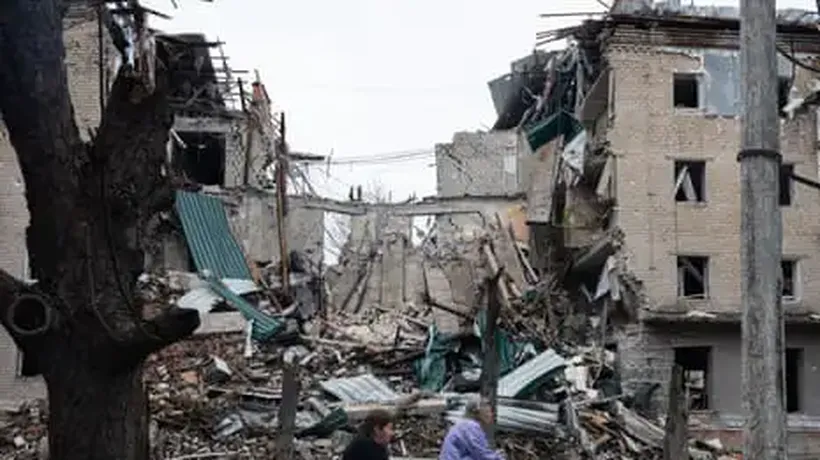
Vladimir Putin’s army hasn’t made much headway in Ukraine this year, and his territorial goals – annexing four Ukrainian provinces – remain elusive, despite more than four and a half years of war. That explains his recent efforts to sap Ukrainians’ will to resist by launching relentless drone and missile strikes against their cities – targeting, among other sites, residential buildings, large open-air markets, shopping malls, the Dobrobut medical centre and the National Academy of Sciences, both in Kyiv. The capital has been hit the hardest, but other cities – Dnipro, Kharkiv, Kherson, Odesa, Mykolaiv, Sumy – haven’t been spared.
Air-raid sirens pierce the quiet of night. People scramble to shelters (assuming there are any nearby) or, in Kyiv, race to below-ground subway stations. Even walking along city streets, shopping, or filling up your car at a garage forecourt – which are prime targets – can lead to injury, or even death.
I got a taste of what these unremitting attacks are like during a September trip to Ukraine. One night in Mykolaiv, I counted more than a dozen alerts between midnight and dawn. In Kopyliv, about 31 miles west of Kyiv, I was having dinner in a restaurant when a deafening bang made the walls shudder. A drone had hit a building about 500m away; orange flames engulfed its roof within seconds.
Incidents like this are now part of daily life for Ukrainians, but are no less nerve-racking for that.
During September, Russia launched 3,177 jet-powered drones, mainly Geran variants, at Ukraine: nearly 12% more than in August, and a massive increase compared with 350 such strikes in June. Drones, jet-powered or not, are often supplemented by ballistic missiles such as the Iskander – devilishly difficult to intercept with its top speed of 5,600mph and ability to swerve in flight.
The purpose of Putin’s escalating bombardment is to make life so unbearable for Ukrainians that they conclude that the only way out is to satisfy his unfulfilled annexationist ambitions: his army occupies almost all of Luhansk, but has yet to conquer the cities of Donetsk, Kherson and Zaporizhzhia completely.
But his drone and missile campaign won’t force Ukraine to cave.
In December 2025, a Kyiv International Institute of Sociology poll revealed that Ukrainians’ resistance to trading land for peace remains strong. Three-quarters of those surveyed rejected a hypothetical deal that included these provisions: Ukraine’s withdrawal from the unoccupied part of Donetsk, recognition of Russia’s legal ownership of Crimea and Donbas, and the abandonment of its Nato aspirations. Asked separately whether they would approve a settlement that required ceding the unoccupied parts of the two southern provinces, two-thirds said no. These responses are all the more significant because by the end of last year, Russia had begun attacking Ukraine’s power grid as a brutal winter approached.
Putin might nevertheless calculate that a massive bombing operation this winter that turns off the lights, disrupts heating and damages waterworks and sanitation systems will break Ukrainians’ willpower, creating conditions for Russia to conclude the war with additional territory in hand. His calculation isn’t unreasonable, considering Ukraine’s severe shortage of ballistic missile interceptors, which reduced interceptions from 70% in March to 20% in July. It’s collaborating with a European coalition to develop the cost-effective Freya ballistic missile defence system, and will acquire the Franco-Italian SAMP/T NG missile defence system, which provides far easier mobility to aid rapid relocation and is now under development. Neither, however, will be deployed in sufficient numbers any time soon.
Still, the Russian leader’s strategy collides with some inconvenient facts, quite apart from Ukrainians’ proven toughness.
The historical record shows that bombing campaigns don’t crush morale; they strengthen it. Ukrainians won’t be the exception. They regard resistance to Russia as essential for national survival. When I’ve asked them why they continue to fight, the reply, in one form or another, is that the alternative is to forfeit their independence. One can dismiss this as bravado, but what matters is that Ukrainians hold this view.
Accompanying it is the widespread belief that Putin will use any deal to buy time and regroup before renewing his assault on Ukraine. This, too, makes Ukrainians wary of land-for-peace formulas, particularly those offered by Donald Trump and his two emissaries, Steve Witkoff and Jared Kushner, whom they consider Putin partisans, rather than disinterested mediators.
Besides, Putin, too, is under pressure. According to the chief of the UK’s defence staff, his army has suffered 1.5 million casualties. And though Ukraine has a military manpower shortage, so does Russia, despite a population that’s 3.5 times larger; hence its reliance on North Korean soldiers and Asian and African mercenaries. Moreover, the Russian army has barely gained any additional territory this year. During the first six months of 2026, it captured only 28% as much land as it did in the same period last year, and its troop losses now exceed its monthly intake by 6,000.
Furthermore, Ukrainian drone attacks on Russia’s roads and rail lines traversing Ukraine’s occupied territory in the south have left its troops in Crimea, Kherson and Zaporizhzhia short of critical supplies. Most recently, Operation Vivaldi, conducted by Ukraine’s 3rd Army Corps, caught Russian troops by surprise in the Lyman sector of northern Donetsk, forcing them to retreat eastward.
The war has harmed Russia’s economy. The army’s huge appetite for manpower has created severe labour shortages that have hurt businesses. The 2027 budget draft allocates 35% of federal expenditures to defence. Ukraine’s strikes on refineries deep inside Russia had cut their throughput by about 30%, year on year, by June, creating chronic fuel shortages, widespread rationing, serpentine lines at petrol stations and a 21% surge in petrol prices since January.
Taken together, Ukrainians’ opposition to sacrificing land, the historical failure of bombing campaigns to shatter civilian morale and Russia’s own assorted problems suggest that Putin’s drones and missiles won’t force Ukraine to accept peace on his terms – even under the stress of winter.
-
Rajan Menon is a professor emeritus of international relations at the City College of New York and a senior research scholar at Columbia University’s Saltzman Institute of War and Peace Studies