
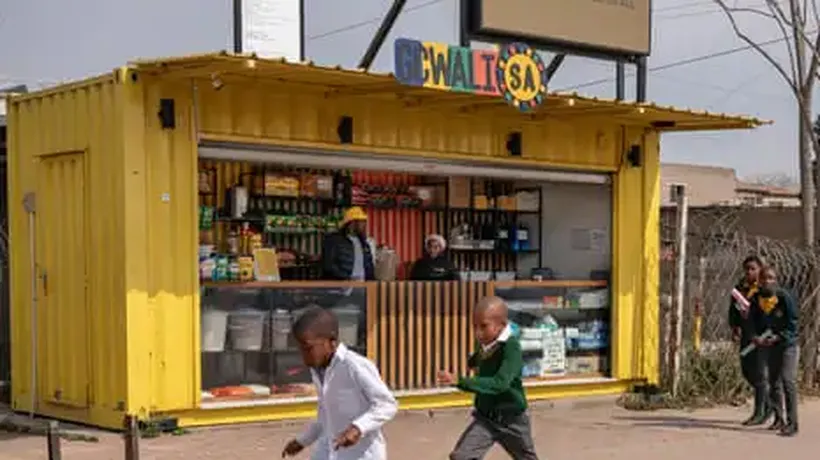
Every morning, on her way to the laundry shop she runs in Johannesburg’s Alexandra township, Tsholofelo Mphela stops at a bright yellow shipping container to buy a few spoonfuls of sugar.
Inside, shelves are lined with large jars of beans, rice and maize meal, and clear boxes filled with breakfast cereal and loose teabags. A tap dispenses cooking oil by the millilitre. The cashier weighs Mphela’s purchase before ringing it up for a few rand.
She is the sole breadwinner for a family of eight, and her monthly bulk grocery shop lasts only about a week. “At times, I don’t have enough money to buy a 2kg bag of sugar,” Mphela says. A 2kg bag costs about 60 rand (£2.80).
At the weigh-and-pay shop Gcwalisa – which means “fill up in isiZulu” – designed to tackle malnutrition in one of South Africa’s poorest communities, she can buy exactly what she can afford.
South Africa has a rich agricultural sector and produces more than enough food to feed its entire population. Yet millions of people still struggle with hunger.
A 2024 national survey found that nearly two-thirds of all households were affected by food insecurity, and nearly 30% of children under five suffered from stunting linked to chronic malnutrition.
Healthy food remains out of reach for many, contributing to issues such as widespread obesity and diabetes – which recently overtook HIV and tuberculosis as the No 1 cause of natural death in the country.
“A lot of townships are food deserts, where nutritious foods are not accessible,” says Josephine Katumba, Gcwalisa’s head of operations. “We are offering people that accessibility – with whatever amount of money you have, it will at least get you through the next few days.”
Launched in 2022, the social enterprise now runs six container-based shops across Alexandra, selling food and basic household products by weight. Customers are encouraged to bring their own refillable receptacles.
Gcwalisa’s weigh-and-pay model is designed to avoid what the founder, Miles Kubheka, calls the “poverty tax”: the fact that poorer families end up paying more for small pre-packaged quantities because they cannot afford to buy in bulk.
Products are sourced directly from local producers, with a focus on nutritious, high-quality foods.
Low-waste shops that sell by weight are not new, Katumba admits, but they are usually set up in more affluent neighbourhoods. “We said: ‘How do we target low-income earners, no-income earners, people who depend on government grants – which are the majority of the population?’”
The shops soon expanded their range to other household essentials, such as detergent, painkillers and period pads. They began stocking nappies after a grandmother asked whether she could buy disposable ones individually. “She said they let them dry in the sun, dust them off and reuse them,” Kubheka recalls.
In 2023, as South Africa endured regular power cuts of up to 12 hours a day, Gcwalisa installed solar panels on some of its containers. They now provide electricity to dozens of surrounding homes and the local school.
“These traffic lights are powered by us,” says Kubheka as he drives through an road junction at the entrance to Alexandra. “We have become a sort of alternative service-delivery platform.”
Outside the yellow container, a group of teenagers in school uniforms do their homework using the free wifi installed by Gcwalisa. One of the shops was recently registered as a medical pickup point, Kubheka adds, allowing patients to collect their HIV or diabetes medication alongside their groceries.
At the till, 65-year-old Sibongile Msomi watches as the cashier weighs out exactly 16 rands (£0.73) worth of Pine Gel cleaner, which she uses to wash her floors. “I just received my pension, but it’s small money,” she says.
South Africa faces a “food system paradox”, says Prof Julian May, who heads the Centre of Excellence in Food Security at Cape Town’s University of the Western Cape. The country is self-sufficient in food and has adopted policies that succeeded in eliminating stunting in children in other countries, such as child support grants and free primary healthcare. But here, he says, they have “failed to budge food insecurity”.
One of the main causes lies in an “astronomically high level of unemployment”, with about 43% of the working-age population without a job, he says. In addition, unlike in many other African countries, where markets and informal traders are important sources of food, supermarkets and formal retailers dominate South Africa’s food system.
“What is affordable in low-income areas is often unhealthy: low-cost, high-calorie, low-nutrient foods,” May says.
Standing behind the till of a Gcwalisa container set up directly opposite a busy supermarket, the shopkeeper, Lerato Khangale, fills a small paper bag with 100g of beans – enough for one person’s dinner.
Many of her customers rely on government grants of 350 rand (£16) a month. “They say we’re helping them, because they cannot afford life,” she says.
Khangale has started shopping at the refill shops herself. “Towards month’s end, when things become so difficult, I just spend my last money here,” she says. “Just those 20 rands, so that I can buy something for my kids.”