
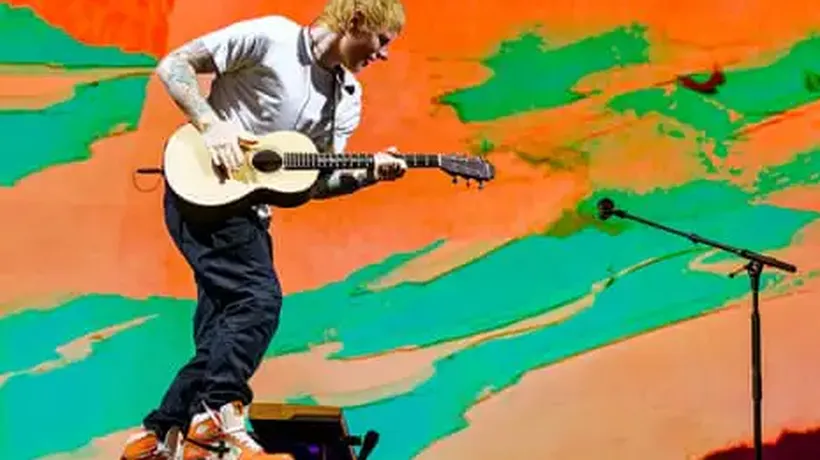
Ed Sheeran, seeking to stay out of politics, has become, in this moment, the most political artist in the world. And in trying to leave himself room to manoeuvre, he has backed himself into a corner. Since the rapper Macklemore was dropped as a support act on Sheeran’s Loop tour on Monday, every other opening act has pulled out. Finneas O’Connell kept it brief on Tuesday: “Artists must not be silenced when they speak up for the oppressed. I stand with Palestine and its people.” Aaron Rowe was already out, saying: “I cannot stand by and allow billionaires to use their position of power to silence … rightful voices.”
Beoga, Sheeran’s actual backing band, then pulled out, along with the Danish band Lukas Graham, who probably made the mildest statement, managing to not even mention any countries: “We should be able to speak about war, about civilians being killed, about children who deserve to grow up. Wherever they live. Whatever flag flies over them.”
Sheeran said the decision to drop Macklemore was entirely down to venue owners and promoters, adding that there was a reason he didn’t talk about politics on stage: “My audience includes young people, often children, of all backgrounds.” Both statements sound weak, but more importantly, it is not true that Sheeran doesn’t take political stances. He has taken part in a fundraising gig for Ukrainians, telling them, “I love you, I stand with you”; in 2017 he outed himself as a “Corbynista fanboy” (TM the Sun), and has been a vocal supporter of LGBTQI+ rights, on stage and off, throughout his career. More specifically, it seems unlikely he didn’t know the views of his support acts when he chose them: Macklemore had a song about Hind Rajab, the five-year-old killed by the IDF in 2024, on his set list; Beoga are founding members of Irish Artists for Palestine.
To try to psychoanalyse Sheeran, and say definitively whether he was trying to borrow the spirit of these artists while distancing himself from their beliefs, or in fact shares their views, would be premature; ultimately, he’s bound to declare himself. So far he has simply said he was “appalled by the conflict between Israel and Palestine” and that the “suffering and pain caused on both sides is a human tragedy”. Just because he didn’t choose to speak publicly, he said, “doesn’t mean I don’t care”.
This omertà won’t hold. But what we can say for certain now is that the idea of keeping politics out of entertainment, music, or art, is last century’s fantasy. Censorship is swift – but often not as overt as in this case. It is simply a fact that if artists don’t studiously avoid voicing certain opinions, they will get caught up in politics. It’s unclear whether it’s possible to create art – at least art that will be seen by a mass public – in those conditions.
At the vanguard of the move to jettison Macklemore from the tour was the Israeli-American Council, whose chief executive, Elan Carr, told the Today programme on Wednesday that the rapper had “put forth a blood libel against the state of Israel and, by connection, the Jewish people”. He was pressed by Justin Webb on what Macklemore actually said: “The words free Palestine don’t necessarily mean … that anything awful should happen to Jewish people or indeed to the state of Israel.” “Free Palestine absolutely is a call for the extermination of the state of Israel and the Jewish people,” Carr replied.
So what kind of Palestine is it acceptable to want? The other difficult strand of Carr’s argument was that a concert audience was “captive … people have paid to be there”. If you’ve paid money to be somewhere, the logic runs, you shouldn’t be subjected to politics of any kind. Yet billionaires have no qualms about having a political agenda. Macklemore, both onstage and in his own statement, has rebuffed the argument that voicing support for Palestinians and criticising Israel and its actions in Gaza and the West Bank is antisemitic. (In 2014, he apologised for a costume he wore on stage, which critics said was antisemitic, saying: “I respect all cultures and all people.”)
The concern of many of the artists was that they were facing not justcensorship, but censorship by billionaires: specifically Robert Kraft, who demanded Macklemore’s removal with the threat of axing the whole show from his Gillette Stadium in Massachusetts. Kraft has so far not commented on Alexandria Ocasio-Cortez’s charge that he put pressure on other stadiums to follow suit. In his own statement, he insisted his decision to ban Macklemore from Gillette was “not about diminishing the suffering of innocent Palestinians or denying anyone the right to advocate on their behalf”, but that such advocacy,“should not … obscure the responsibility of Hamas”.
What next, Ocasio-Cortez asked an interviewer, rhetorically: “It could be speaking out about AI … you can now just get a handful of stadium owners to ensure that an entire person’s career can be jeopardised.”
Ultimately, now, the only acceptable thing to say is nothing: there is no statement mild enough about Israel and Palestine that can be made on a stage to a general audience. Even to wish for a world in which children aren’t killed is too political, and even the Sheeran fix – that there’s a lot of pain on both sides – which might or might not have been devised to soothe billionaire interests, does not meet their preference. They would simply prefer that everyone pretend the situation doesn’t exist, that they’ve never heard of it, that nothing has happened, and if anything ever had, they wouldn’t be able to find it on a map. The slippery slope argument, that an enforced public silence could spread to protests against datacentres next, is plausible but unnecessary: we don’t need this censorship to get worse before we take it seriously.
-
Zoe Williams is a Guardian columnist