
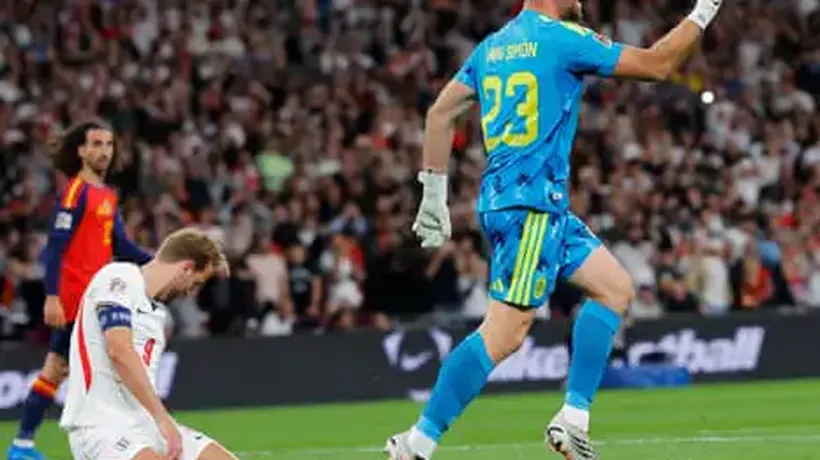
You could feel it inside the stadium, one of those moments where the air starts to shift, the birds fly backwards through the sky, and outside on Wembley Way an old man clutches his copy of the England Pathway Blueprint to his chest and cowers up at the moon. Welcome to the witching hour, 55 minutes in, when things just seem to happen to Thomas Tuchel’s England.
Before this Nations League opener there was general agreement on the desirability of systems, pattern, repeatability. And you can’t say England aren’t consistent. Their last two significant matches, here and in Atlanta in July, have both involved going a goal ahead against the World Cup finalists, playing well and dominating parts of the game, right up until the 55-minute mark.
At which point a kind of voodoo descends. On both occasions the final 35 minutes have been lost 2-0. On both occasions there will, inevitably, be an attempt not just to blame the manager for decisions made in the game, but for some kind of wider vibes-based DNA-related betrayal. “Cowardice” is a word most often used, because football is of course war, bravery and pluck. But it is, as ever with England, technical and tactical. As it was once again here.
There were 55 minutes gone against Argentina in Atlanta when Anthony Gordon put England 1-0 up. At which point the team fell apart like an over-dunked digestive biscuit, reduced suddenly to a collection of hollow men, stuffed shirts, 12% possession merchants, the manager spooked into fielding a back five.
Here the game also changed on 55 minutes. England were 2-1 up from 1-0 down at that point. For a while at the start of the second half it looked like they might be turning this game into an ordeal for their opponents, playing in surges, winning physical duels, making Spain into a team that has to run.
Jarell Quansah smashed a shot into Marc Cucurella’s face, drawing huge cheers. The crowd had begun to sing the Tuchel song, to the tune of War’s Low Rider, the official notation for which is “Foot-ball’s coming home uh-gain – with Thom-as Tuch-el”. On 54 minutes a lengthy VAR check ended with a penalty awarded for a trip on Jude Bellingham that was combined also with a dive, but trip plus dive does not cancel trip. Was this an exorcism? Are we good now? Is everything going to be OK?
Well, no, as it turned out. Harry Kane had already scored England’s second goal. He waited a little longer than usual, slipped on his standing leg as he planted it and pumped the kick on to the bar. 54 ticked over into 55 minutes.
And at that point Spain just seemed to sense it, the pressure shifted and we were back in Georgia under the lights. Tuchel was up again on his touchline, arms wheeling, shiny blue gilet gleaming. The ball began to tick about between the red shirts. And suddenly Spain had regained that basking quality, easing about with that familiar sense of control, always with more angles, more space, a superior geometry, like trying to keep up with a team of 11-year-old chess prodigies.
Within five minutes the game was level. Fourteen minutes later Spain were 3-2 up, a lead they would hold on to. The most unfavourable interpretation of this is a pattern being established. England lost another game where they just seem to get close, to lose control, to fail to hold the midfield. Both of Spain’s decisive goals were either made or scored by Luis de la Fuente’s two attacking substitutes, neither of whom looked much like Dan Burn.
But it wasn’t quite like that. For a start, England were much better here than in Atlanta, and against a better team. Wembley was its usual chilly self at kick-off, a place where even on a Saturday night the general vibe is echoey, corporate space, like a visit to the Ideal Home exhibition or a peculiarly low-throttle ABBA tribute event.
And Spain scored almost immediately, the goal made by a horrible moment for Marc Guéhi and a smart finish from Yamine Lamal. For a while this was the sum of all fears, one of those games where facing this team is like trying to play football against water. Ferran Torres wasted some outrageously inviting chances. Rodri shuttled about like a man operating inside his own portable demilitarised zone. Spain will make you crawl in those moments. But England didn’t let them.
There were periods of hard high pressing. Elliot Anderson was aggressive in midfield. On 36 minutes England scored a brilliant goal, one that Spain will hate, caught on the counterattack by a wonderful three-man surge from box to box, made by Anderson’s tackle, Bellingham’s surge and pass, and a lovely Gordon finish into the corner.
They kept running from there. And even after the 55-minute fade England were better. There was no long-ball stuff, no panic and some decent late chances. But really the key moment here came on 70 minutes, when both teams brought on a midfielder: Pedri for Spain, James Garner for England.
Pedri immediately began to do his thing, romping about like a playful little horse, a footballer who just loves the ball, and whom the ball loves right back. At that point Spain had Pedri, Rodri and Dani Olmo, the entire Barcelona midfield, on the pitch. And for all England’s efforts, the late surge, the front-foot style, it always felt that they were being held at bay in those final moments, one hand on the forehead, arms windmilling in the space in between.
But then Spain are the ultimate system team, an expression of a deep, functioning coaching culture, not to mention the footballing nation that tortures England the most. We are all you could have had, the thing you are not. Lose again, lose better. But this was at least some kind of progress.