
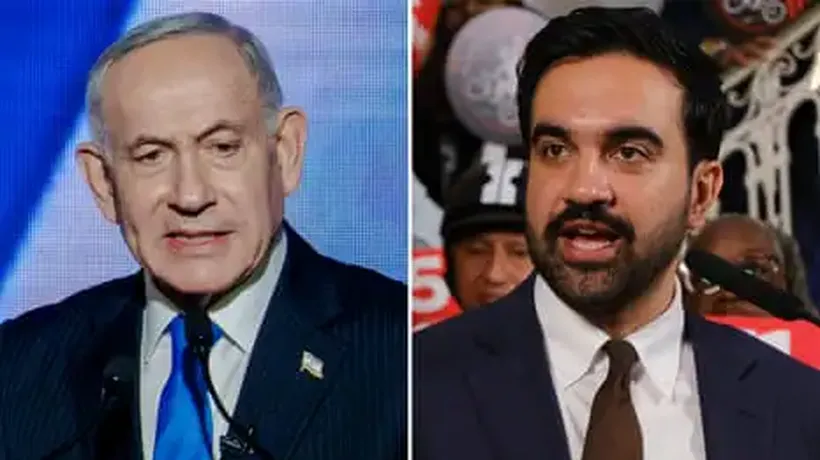
In a boastful and defiant speech to the United Nations on Thursday, Benjamin Netanyahu called out a list of villains he insisted are intent on destroying Israel and promoting an anti-Jewish conspiracy by accusing Israel of committing a genocide in Gaza. He singled out the leaders of Hamas, Iran, Qatar and Turkey, among others. But Netanyahu spent considerable time on the global stage attacking an unusual target: Zohran Mamdani, the mayor of New York City.
Netanyahu accused Mamdani of promoting antisemitism, falsely claimed that he supports Hamas, and argued that since the mayor took office in January, “many Jews no longer feel safe in New York.” The Israeli leader also criticized Mamdani’s wife for liking social media posts that supported the Palestinian cause soon after the Hamas attack on Israel in October 2023. Overall, Netanyahu seems to have devoted more time in his nearly 40-minute speech to singling out Mamdani than any other political leader, including Israel’s traditional enemies.
On the surface, it might seem that Netanyahu’s attacks were mainly motivated by personal animosity toward Mamdani, who pledged during last year’s mayoral campaign to execute an arrest warrant against the Israeli premier for war crimes and crimes against humanity issued by the international criminal court (ICC) in 2024. “Mr. Mamdani, you tried to stop me from coming here, you tried to silence me,” Netanyahu said from the UN podium, referring to the mayor’s promise to enforce the ICC warrant the next time the Israeli leader visited New York. “You can’t silence me. You can’t silence the truth.”
But Netanyahu is not only driven by his personal dislike of Mamdani: the democratic socialist mayor has become popular among Democrats across the US, who are increasingly critical of Israel. And that makes Mamdani a useful foil for the Israeli prime minister, who is in the midst of one of the toughest re-election campaigns of his career. Netanyahu is fighting for his political survival, with his rightwing governing coalition at risk of losing Israel’s parliamentary elections next month.
Netanyahu, who is often described as “the great survivor” of Israeli politics, has decades of experience demonizing his opponents and focusing Israelis on external enemies. Since October 2023, Netanyahu has prolonged Israel’s genocidal war on Gaza, and a wider regional war, so he could avoid early elections and block an independent commission into his government’s security failures that led up to the Hamas attack. Netanyahu is also clinging to power to save himself from a years-long corruption trial stemming from one of his earlier stints as premier, where he has been accused of providing political favors to wealthy supporters in exchange for gifts or positive media coverage.
Netanyahu’s UN speech wasn’t the first time he has targeted Mamdani – largely to curry favor with a domestic Israeli audience that views the young Muslim, pro-Palestinian mayor of New York as a villain. Israel’s Likud party has been whipping up an election frenzy against Mamdani since the summer, when it plastered his photo on a campaign billboard in central Tel Aviv. The poster features Mamdani alongside Iran’s supreme leader, Mojtaba Khamenei; Turkey’s president, Recep Tayyip Erdoğan; and Naim Qassem, the leader of Lebanon’s Hezbollah militia. “They want Netanyahu to lose,” says the poster, which features the logo of the rightwing Likud party that Netanyahu has dominated for decades. “Don’t let them win.”
Earlier this month, Netanyahu continued his attacks lumping Mamdani with Middle East leaders who are the Israeli premier’s usual targets. Netanyahu posted an AI-generated video on his personal X account that showed Mamdani celebrating at the prospect of Netanyahu’s defeat in the upcoming elections. “Erdogan, bro, are you coming to the party of the fall of Netanyahu elections?” an AI version of Mamdani asks in a supposed phone call with the Turkish leader. The fake video also features Khamenei and Mahmoud Abbas, president of the Palestinian Authority, reveling at the prospect of Netanyahu’s downfall.
But the video goes on to show Netanyahu defeating his political opponents in Israel – forcing Mamdani and the others to cancel their celebration. “They want Netanyahu to fall. Don’t let them win,” a narrator says in Hebrew in the video’s closing message.
For his part, Mamdani fought back against Netanyahu’s attacks, but he has also tried to keep the focus on international law and the importance of carrying out the ICC’s arrest warrant. Mamdani said the Israeli leader had used his UN speech to “repeat baseless lies meant to sanitize his genocide of Palestinians … Yet no lie can change the fact that he remains the subject of an international criminal court arrest warrant alleging war crimes and crimes against humanity.”
In July, Mamdani released a video on X in which he backed away from his campaign pledge to arrest Netanyahu, and acknowledged that New York’s police department does not have the legal authority to carry out the ICC’s arrest warrant. Mamdani called the Israeli premier a “war criminal” and “the architect of a horrific genocide against the Palestinian people”, and he urged the federal government to arrest Netanyahu on his next visit to the US.
But there’s virtually no chance of that happening. Joe Biden and Donald Trump rejected the ICC’s accusations against Netanyahu – in keeping with their unwavering support for Israel and the billions of dollars in US weapons sent by both of their administrations to enable Israel to carry out its genocide in Gaza. Trump has threatened to impose crippling sanctions against the international court to pressure it to revoke the warrant against his friend and ally Netanyahu. In July, the secretary of state, Marco Rubio, pledged to lead an American campaign to dismantle the ICC “brick by brick, if necessary”.
Netanyahu’s arrogant speech to the UN – coupled with the Trump administration’s deep hostility to the ICC and other institutions intended to uphold international law – might reinforce the idea that impunity will always win under a global order imposed by brute force.
But Mamdani’s effort, even if it has failed so far, offers fleeting hope that justice could prevail – and Israel’s leaders will one day be held to account for their war crimes.
-
Mohamad Bazzi is a Guardian US columnist. He is also director of the Center for Near Eastern Studies and a journalism professor at New York University